Luxury & New Construction/A Mano
Luxury & Custom Homes · A Mano

A Manothe hand-brushed finish.

Applied entirely by hand with brush. No spray. No roller. A finish for rooms and elevations meant to be looked at closely — and a surface that can be touched up invisibly twenty years from now.

The Service

What it is

Most good painting today is sprayed and back-rolled. It is fast, it is even, and for most houses it is the right call — we do it every week and we do it well.

A Mano is the other thing. Every coat is laid on with a brush, laid off, and tipped out in one direction, working to a wet edge across the whole surface. The brush forces coating into every pore, hairline check and profile the substrate has. It builds a deeper, more uniform film than a sprayed application of the same product, and it leaves the faint hand of the tradesman in the surface rather than a machine-flat plane.

It is slower by a factor of five. That is not an inefficiency to be apologized for. It is the service.

The Case

Why it lasts

Film build

A brushed coat carries more material than a sprayed one and works it into the surface rather than laying it on top. More film is more years.

No thin edges

Spray thins at every edge, corner and profile return — the exact places weather and wear find first. A brush cannot leave those places short.

Invisible touch-up

A brushed surface accepts a brushed repair. There is no sprayed texture to match, so a scuff in year eight disappears instead of announcing itself.

Cut lines, not tape lines

Every line is cut by hand at the substrate. Nothing depends on tape, and nothing bleeds under it.

The Fit

Where it belongs

This is not the finish for a rental turn or a tract repaint, and we will tell you so. It belongs where the surface is part of the architecture.

Milled trim, doors and moldingsCraftsman and traditional casing, panel doors, built-in cabinetry — profiles a spray gun flattens and a brush reveals.
Walls in the Italian mannerHand-laid wall finishes with visible movement in the surface, the way plaster and lime were worked before rollers existed.
Historic and period exteriorsOlder siding, eaves and cornice where forcing coating into open grain buys the wood years it would not otherwise get.
Rooms that get looked atEntries, libraries, stair halls, dining rooms — the surfaces guests stand next to rather than walk past.
The Standard

Written down before we start

Every A Mano proposal names the exact coating system, the number of coats, the sheen, and the surfaces included — before a brush is lifted. Product technical and safety data sheets accompany the proposal.

We work to the Painting Contractors Association Industry Standards, the nationally recognized consensus documents for this trade. Two govern this service directly: PCA P1, which establishes the criteria for a properly painted surface, and PCA P19, which defines the field of decorative finishing. Where a finish is a decorative system rather than a coating, it is specified and sampled as one.

A sample is prepared on site, in your light, and approved by you before production begins. Color is decided through Chromatica™, included with every project.

SPECIFIED IN WRITING · SAMPLED BEFORE PRODUCTION · SUBSTITUTIONS ONLY IN WRITING

Velatura

The veiled wall

Velatura is the Italian term for a thin, translucent veil of color laid over an established ground, so that what lies beneath shows through. The depth does not come from what covers the wall. It comes from what the wall is allowed to show.

It is the technique behind the finishes people describe when they say they want a room that looks like it has always been there — and it cannot be sprayed, because the variation across the surface is the entire point and a gun’s purpose is to eliminate variation.
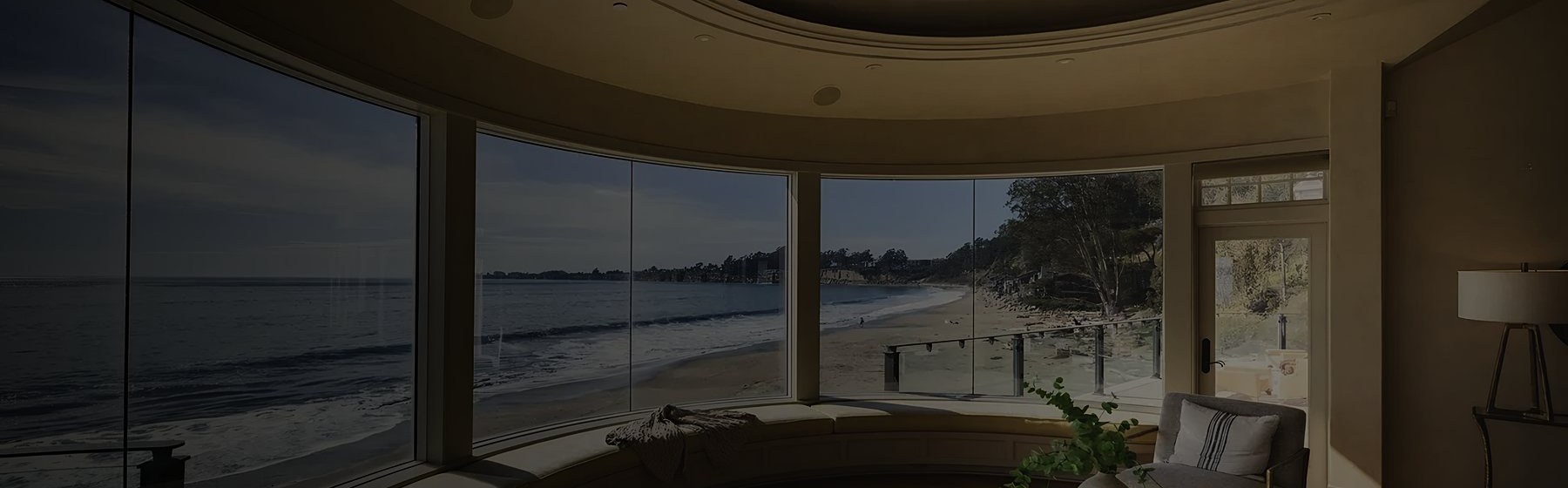
Rounded plaster walls, soffits and crown under a hand-brushed velatura, a beach home on the Aptos coast

A beach home on the Aptos coast

A home on the sand, finished entirely by hand. The walls carry a hand-brushed velatura in Iron Clad oil-based enamel — a coating with the open time to hold a wet edge across a full elevation, which is what makes brushwork possible at that scale.

The tones were chosen to sit almost on top of one another. The separation is deliberately negligible: enough to move, never enough to announce itself. What the room reads as is not a decorative finish. It reads as sand.

I. Two tones, every surfaceBoth tones laid on by brush across walls, soffits, trim, casings and crown — chosen close, for movement rather than contrast.
II. Hand-burnishedEvery surface worked back with a mildly abrasive pad. This is the step no one guesses and the one the finish depends on: burnishing opens the cured enamel just enough to accept the glaze evenly, instead of letting it skid across a sealed film.
III. The glaze, brushed by handA transparent veil of mineral spirits, Penetrol and the same Iron Clad enamel, proportioned to the room and its light, then laid on and worked out by hand across every plane.
IV. Architecture, not decorationThe soffits were painted into the color that inspired the glaze. Rounded plaster walls, soffits, trim, casings and crown resolve into one another, so the angles and curves of the house read as intentional rather than as a surface applied to them.

Oil over burnished oil, top to bottom — one chemical family, one hand. Twenty years on the sand, and it has not let go.
Marine brightwork on the Aptos coast, varnish laid off and tipped out by hand, 2006
Marine brightwork, Aptos coast, 2006. Varnish laid, laid off and tipped out by hand — the discipline the walls were finished with, at close range.
Hand-worked entry door with grain and depth built by hand, 2006
Hand-worked entry door, 2006. Grain and depth built by hand rather than printed on by a gun.

Where the brush stops

One exception on that job, and it is the one that proves the rule. The mahogany and walnut millwork and the cabinetry carry a two-part conversion varnish — a catalyzed coating that cures by chemical reaction, at a film thickness and a flash time no brush can meet. Those were sprayed, because on that coating a brush produces a worse finish, not a better one. Where hand-work still belonged, it went in as glaze: color and depth worked by hand, the protective coat sprayed.

The coating decides the tool.

We brush where brushing builds a better film. We spray where the chemistry demands it. And we tell you which is which before you sign.

Who It Is For

People who intend to keep the house

A Mano costs multiples of a sprayed finish and takes multiples of the time. It is worth that to a certain kind of owner and a certain kind of builder, and it is worth nothing at all to anyone else. If you are weighing it, walk the room with us and we will tell you honestly whether the surface will show the difference.

Request a Walkthrough
Call Estimate